Background
By the beginning of 2025, the Russia–Ukraine war had entered its fourth year, evolving into a prolonged conflict defined by attrition rather than rapid offensives. The war increasingly shaped European security, global energy markets, and relations between major powers, with neither side able to secure a decisive victory.
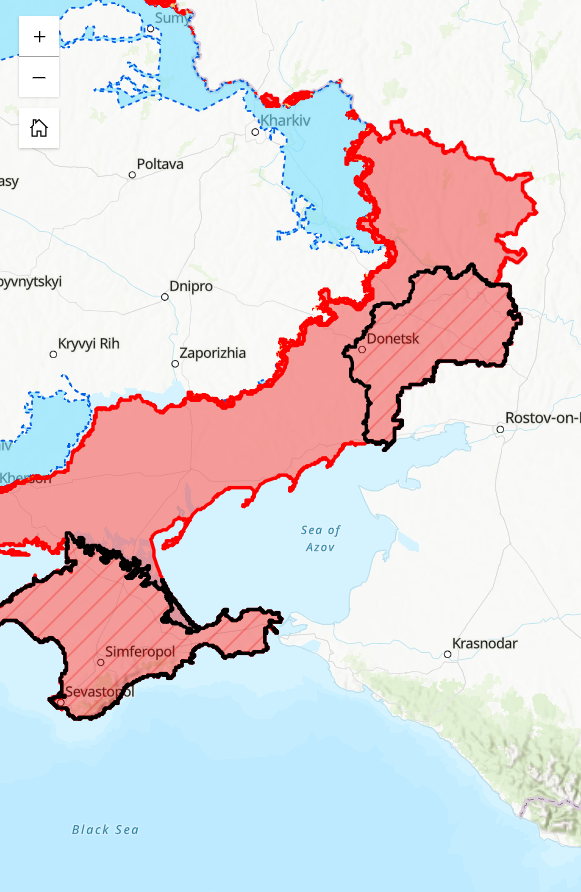
Interactive time lapse MAP 2025 – Ukraine -Russia war.https://experience.arcgis.com/experience/76ad11263f70489f95e78cfa9e9aa846
Battlefield Situation and Territorial Shifts
Throughout 2025, territorial control shifted only marginally, but developments generally favored Russia in specific sectors of eastern Ukraine. Russian forces made slow, incremental advances, particularly in parts of the Donetsk region and surrounding front-line areas. Russia made its largest territorial gains in Ukraine last year since the early months of the full-scale invasion in 2022, according to an AFP analysis. The Russian military captured more than 5,600 square kilometers (2,160 square miles) of Ukrainian territory in 2025 — about 0.94% of the country — based on data from the U.S.-based Institute for the Study of War.
Ukraine succeeded in preventing major breakthroughs and holding key defensive lines, but lacked the resources to reclaim large areas of occupied territory. By the end of the year, the front lines reflected a grinding war of attrition, with control changing village by village rather than through major offensives. On Monday, December 29, Russian Foreign Minister Sergey Lavrov accused Ukraine of attempting to assassinate Russian President Vladimir Putin at his residence at Lake Valdai, 140km (87 miles) northeast of Moscow. “The Kyiv regime launched a terrorist attack using 91 long-range unmanned aerial vehicles (UAVs) on the state residence of the president of the Russian Federation in the Novgorod Region. All the UAVs were destroyed by the air defence systems of the Russian Armed Forces,” said Lavrov in a statement.
Russia’s Military Strategy
Russia’s strategy in 2025 focused on outlasting Ukraine and its Western supporters. Moscow relied on:
- Sustained artillery fire and glide bombs
- Expanded use of drones and long-range missiles
- Large manpower reserves and steady weapons production
Russian forces prioritized weakening Ukraine’s military and civilian resilience rather than seeking rapid territorial conquest. Attacks on logistics routes and energy infrastructure were intended to strain Ukraine’s economy and morale over time.
Major Russian Bombing Campaigns
Russia significantly intensified its long-range bombing and missile campaign during 2025. Large-scale attacks targeted:
- Power plants, substations, and transmission networks
- Industrial facilities linked to defense production
- Urban centers, resulting in civilian casualties and displacement
These strikes caused repeated electricity shortages and placed enormous pressure on Ukraine’s air defense systems. The extensive use of glide bombs allowed Russian aircraft to strike from safer distances, reducing their exposure to Ukrainian defenses.
Ukraine’s Challenges and Response
Ukraine faced mounting challenges in 2025, including shortages of ammunition, air defense interceptors, and manpower. President Volodymyr Zelensky repeatedly warned that sustained resistance depended on continued Western military support.
Despite these difficulties, Ukraine adapted by emphasizing asymmetric warfare, improving its drone capabilities and focusing on precision strikes rather than large ground offensives.
Ukrainian Drone and Long-Range Strikes
Ukraine expanded its use of long-range drones, carrying out strikes deep inside Russian territory. Ukrainian attacks targeted:
- Oil refineries and fuel depots
- Military airfields and logistics hubs
- Infrastructure supporting Russia’s war effort
While these attacks did not fundamentally alter the battlefield, they disrupted Russian energy processing, forced Moscow to reinforce air defenses, and demonstrated Ukraine’s ability to project power beyond the front lines.
Commander-in-Chief Valery Gerasimov broadcast exaggerated claims of success. He said Russian forces had occupied 6,640 square kilometres (2,564 square miles) of Ukrainian territory and seized 334 Ukrainian settlements in 2025. The ISW said it had “observed evidence indicating a Russian presence in 4,952 square kilometres (1912 sq miles)” and 245 settlements.
Ukrainian commander-in-chief Oleksandr Syrskii said territory amounting to 0.8 percent of Ukraine’s 603,550sq km (233,032sq miles) had been lost. at the cost of almost 420,000 dead and wounded Russians. Ukraine’s General Staff estimated total Russian casualties for the war at more than 1.2 million, almost 11,500 tanks and 24,000 armoured fighting vehicles, more than 37,000 artillery systems, 781 aircraft and well in excess of 4,000 missiles.
Political Shift in the United States
The inauguration of Donald Trump as U.S. president in January 2025 marked a significant shift in Washington’s approach. While U.S. support for Ukraine continued, it became more conditional, with greater emphasis on European burden-sharing and the pursuit of negotiations.
Trump publicly argued that the war required a diplomatic solution and that Europe should take greater responsibility for Ukraine’s defense. This change increased uncertainty in Kyiv and prompted European governments to reassess their long-term security commitments.
Trump–Zelensky Engagement
President Trump and President Zelensky met during 2025 amid growing diplomatic pressure to explore political pathways. Ukraine sought security guarantees and sustained military aid, while the U.S. administration emphasized de-escalation and negotiations.
These meetings highlighted the widening gap between Ukraine’s military needs and shifting political priorities among its key partners.
NATO and Europe’s Role
European countries responded by increasing defense spending and strengthening military coordination. NATO reinforced its eastern flank, and individual European states continued providing weapons, training, and financial assistance.
However, divisions emerged within Europe over long-term funding, war fatigue, and the risks of escalation with Russia. While support for Ukraine remained strong, the sustainability of that support became an increasingly open question.
Russia’s Economy and Global Partnerships
Despite sanctions, Russia adapted its economy to prolonged conflict. Energy exports remained a key revenue source, supported by discounted oil sales to countries such as India and China. India emerged as one of Russia’s largest oil buyers, providing Moscow with financial stability despite Western restrictions.
These trade relationships helped Russia maintain domestic stability and continue funding its war effort.
Diplomatic Efforts and Stalemate
Diplomatic initiatives continued throughout 2025, involving Western governments, international organizations, and non-aligned states. However, negotiations remained stalled. Ukraine insisted on full territorial integrity, while Russia demanded recognition of its territorial gains and security guarantees.
No comprehensive peace framework emerged.
Status by End of 2025
By the end of 2025, the Russia–Ukraine war remained unresolved. Russia controlled occupied territories and maintained pressure through sustained firepower, while Ukraine resisted but faced growing strain. The conflict increasingly appeared as a long-term geopolitical confrontation rather than a war approaching resolution.
The events of 2025 reinforced the reality that the war’s outcome would depend not only on battlefield developments, but also on political decisions in Washington, Europe, and beyond.
About The Author

Discover more from thecriticspoetry
Subscribe to get the latest posts sent to your email.